
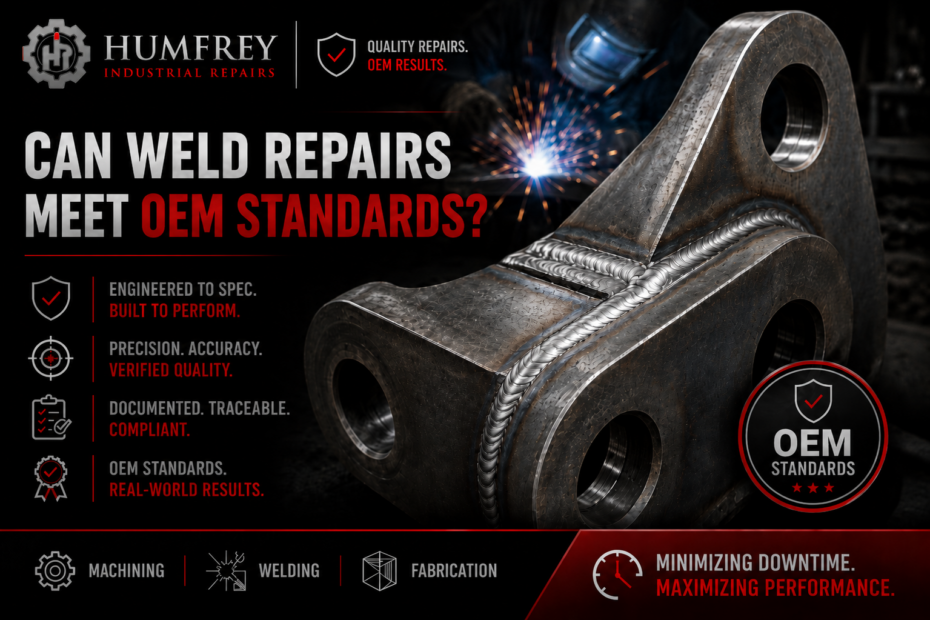
Can Weld Repairs Meet OEM Standards?
When a critical piece of equipment develops a crack, broken bracket, or structural damage, one of the first questions many equipment owners ask is: Can weld repairs meet OEM standards?
The answer depends on several factors, including the type of equipment, the material being repaired, the cause of the damage, and whether the repair follows qualified welding procedures and engineering best practices.
In many cases, professionally executed weld repairs can safely restore equipment to service while maintaining structural integrity and performance. However, not every damaged component is a suitable candidate for repair.
At Humfrey Industrial Repair, every welding repair begins with a thorough assessment to determine the safest and most effective solution.
What Does “OEM Standard” Mean?
OEM stands for Original Equipment Manufacturer. OEM standards refer to the specifications established by the manufacturer for materials, dimensions, welding procedures, heat treatment, tolerances, and overall performance.
These standards are designed to ensure that equipment operates safely and reliably under its intended service conditions.
When evaluating a repair, the goal is not simply to “make it look good.” The repair must restore the component’s ability to perform its intended function safely and reliably.
When Weld Repairs Are Appropriate
Many industrial components can be successfully repaired through welding when the damage is localized, and the base material remains structurally sound.
Common examples include:
- Cracked buckets and attachments
- Equipment frames
- Mounting brackets
- Structural supports
- Wear components
- Industrial fabrication assemblies
- Heavy equipment accessories
When proper repair procedures are followed, these components can often return to service with excellent long-term performance.
When Replacement May Be the Better Option
While welding is an effective repair method, there are situations where replacement is the safer choice.
Examples include:
- Extensive structural fatigue
- Severe corrosion
- Major distortion
- Damage affecting critical safety components
- Components that exceed repair limits established by the manufacturer
An experienced repair facility will evaluate the condition of the component before recommending repair or replacement.
Factors That Determine Repair Quality
A successful weld repair depends on much more than the welder’s skill.
Several factors influence the outcome:
Proper Material Identification
Different steels and alloys require different welding procedures.
Correctly identifying the material ensures compatible filler metals, appropriate welding techniques, and proper heat control.
Qualified Welding Procedures
Every repair should follow documented procedures appropriate for the material and application.
This includes:
- Joint preparation
- Welding process selection
- Preheat requirements
- Interpass temperature control
- Filler metal selection
- Inspection after welding
Following qualified procedures helps produce consistent, high-quality repairs.
Surface Preparation
Successful repairs begin long before welding starts.
The damaged area must be cleaned, prepared, and inspected to remove:
- Cracks
- Contaminants
- Oil
- Rust
- Previous failed weld material
Proper preparation allows the new weld to bond correctly with the base material.
Inspection and Quality Control
Professional repairs include inspections before, during, and after welding.
Depending on the application, inspections may involve:
- Visual examination
- Dimensional verification
- Crack detection
- Surface inspection
- Fit-up verification
Quality control helps ensure the repair performs as intended once the equipment returns to service.
Why Experience Matters
Heavy equipment repairs involve more than depositing weld metal.
Understanding load paths, fatigue, equipment operation, and structural design is essential to producing repairs that withstand demanding industrial environments.
Poorly executed repairs may:
- Crack prematurely
- Distort components
- Affect alignment
- Create new stress concentrations
- Increase future maintenance costs
Experienced industrial welders understand how repair techniques influence long-term equipment performance.
The Role of Machining After Welding
Many repairs require machining after welding to restore proper dimensions.
Examples include:
- Bearing bores
- Pin bores
- Mounting surfaces
- Shaft supports
- Hydraulic component interfaces
Combining welding with precision machining ensures repaired components meet dimensional requirements and function correctly during operation.
How Humfrey Industrial Repair Supports Industrial Welding Repairs
At Humfrey Industrial Repair, welding is often integrated with machining, fabrication, and equipment rebuilding to provide complete repair solutions.
Our capabilities include:
Structural Welding
Repairing cracked frames, brackets, supports, and heavy equipment structures.
Precision Machining
Restoring critical dimensions after welding for proper fit and performance.
Custom Metal Fabrication
Manufacturing replacement sections or reinforcing damaged components when required.
Equipment Restoration
Combining multiple repair processes to extend equipment life and reduce replacement costs.
The Benefits of Professional Weld Repairs
When completed correctly, weld repairs can provide significant advantages:
- Reduced downtime
- Lower repair costs compared to replacement
- Extended equipment lifespan
- Restoration of structural integrity
- Improved return on equipment investment
For many industrial operations, repair offers the most practical and economical solution.
Choosing the Right Repair Partner
Not every welding shop has the experience or equipment required for heavy industrial repairs.
When selecting a repair provider, consider:
- Experience with heavy equipment
- Qualified welding procedures
- Precision machining capabilities
- Fabrication expertise
- Quality inspection processes
- Ability to evaluate repair versus replacement
Choosing a qualified repair partner helps ensure repairs are completed safely and effectively.
Final Thoughts
So, can weld repairs meet OEM standards?
In many cases, yes—provided the repair is appropriate for the component, follows qualified welding procedures, and includes the necessary inspection and quality control measures.
Professional weld repairs can restore structural integrity, extend equipment life, and reduce the cost of replacement while keeping critical machinery operating efficiently.
At Humfrey Industrial Repair, we combine expert welding, precision machining, custom fabrication, and industrial repair services to deliver dependable solutions for Alberta’s heavy industries.