
Why Understanding Internal vs External Keyways Matters
In heavy industrial equipment, even small, machined features play a critical role in keeping machinery operating safely and efficiently. One of the most important is the keyway. Although often overlooked, a properly machined keyway ensures reliable torque transmission between shafts, gears, pulleys, sprockets, couplings, and hubs. Understanding internal vs external keyways helps equipment owners, maintenance teams, and engineers select the correct design for their application while preventing premature wear and mechanical failure.
At Humfrey Industrial Repair, precision keyway machining is part of the complete machining services we provide for Alberta’s industrial, oil and gas, manufacturing, agricultural, and construction sectors.
What Is a Keyway?
A keyway is a precision-machined slot that allows a key to lock two rotating components together. The key prevents relative movement between the shaft and the mounted component while allowing torque to be transmitted efficiently.
Keyways are commonly found in:
- Drive shafts
- Gearboxes
- Electric motors
- Hydraulic pumps
- Conveyor systems
- Couplings
- Pulleys
- Sprockets
- Industrial fans
- Agricultural equipment
Without a properly machined keyway, components can slip, wear rapidly, or fail under load.
What Is an Internal Keyway?
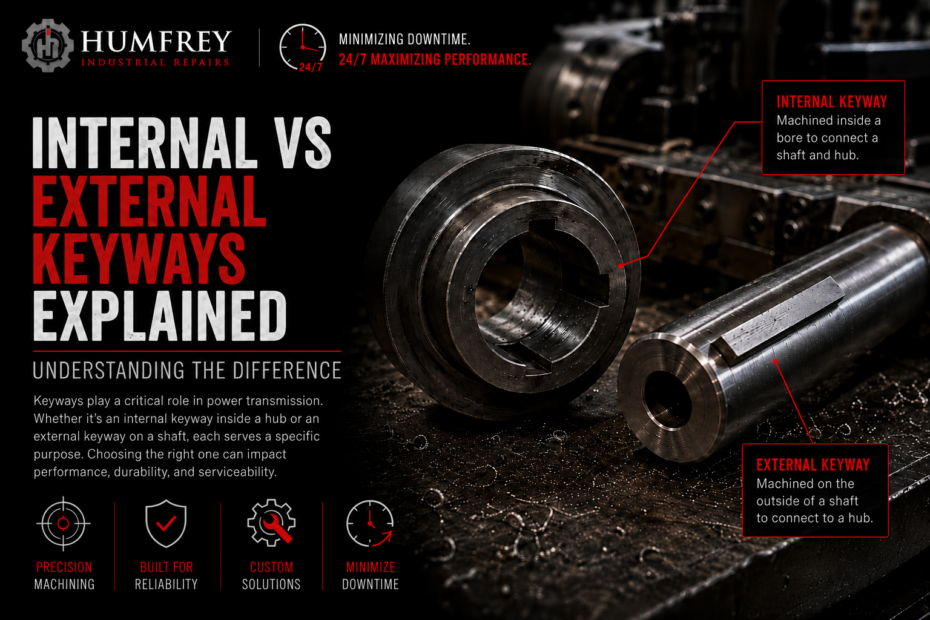
An internal keyway is machined inside the bore of a component.
Examples include:
- Gears
- Pulleys
- Couplings
- Bushings
- Sprockets
- Flywheels
The matching key fits inside the hub and engages with the shaft, allowing both components to rotate together.
Internal keyways are commonly produced using:
- Broaching
- Slotting
- Shaping
- CNC machining
- Wire EDM for specialized applications
The machining method depends on the material, size, and production requirements.
What Is an External Keyway?
An external keyway is machined directly into the outside diameter of a shaft.
Common applications include:
- Pump shafts
- Motor shafts
- Hydraulic equipment
- Conveyor drive shafts
- Industrial gearboxes
- Power transmission systems
External keyways are typically machined using:
- Vertical milling machines
- Horizontal milling machines
- CNC machining centers
- Slotting equipment
The finished keyway must maintain tight dimensional tolerances to ensure proper key fit and reliable power transmission.
Internal vs External Keyways: What Is the Difference?
Although they work together, internal and external keyways serve different functions.
Internal keyways:
- Machined inside a hub or bore
- Hold the key within the mounted component
- Commonly produced through broaching or slotting
- Used in gears, pulleys, and couplings
External keyways:
- Machined into a shaft
- Support torque transfer from the shaft
- Commonly produced through milling or slotting
- Used on rotating shafts throughout industrial equipment
Both must align precisely to prevent uneven loading and premature wear.
Why Precision Matters
Keyways may appear simple, but even small dimensional errors can cause significant mechanical problems.
Improperly machined keyways can result in:
- Loose component fit
- Key movement
- Fretting corrosion
- Shaft wear
- Hub damage
- Excessive vibration
- Power loss
- Premature component failure
Precision machining ensures proper width, depth, alignment, and surface finish for reliable operation.
Common Causes of Keyway Damage
Over time, keyways experience repeated loading cycles that can lead to wear or failure.
Common causes include:
- Excessive torque
- Poor lubrication
- Improper key fit
- Corrosion
- Shock loading
- Equipment misalignment
- Worn shafts or hubs
- Fatigue from repeated operation
Early inspection can prevent minor wear from developing into costly equipment failures.
Can Damaged Keyways Be Repaired?
In many cases, yes.
Depending on the condition of the component, repair options may include:
- Precision re-machining
- Oversized keyways
- Weld build-up followed by machining
- Shaft repair
- Hub restoration
- Custom key manufacturing
Repairing an existing component is often more economical than replacing expensive industrial equipment.
How Humfrey Industrial Repair Machines Keyways
At Humfrey Industrial Repair, keyway machining is performed using precision equipment capable of producing accurate internal and external keyways for a wide range of industrial applications.
Our capabilities include:
Internal Keyway Machining
Using broaching, slotting, or other precision machining methods to restore or manufacture internal keyways in gears, couplings, hubs, and other components.
External Keyway Machining
Machining accurate shaft keyways to restore worn components or manufacture new shafts to customer specifications.
Precision Machining
Maintaining tight tolerances to ensure proper fit, alignment, and long-term performance.
Custom Component Manufacturing
Producing replacement shafts, hubs, couplings, and custom-machined parts when OEM components are unavailable.
Choosing the Right Machining Partner
Successful keyway machining requires precision measurement, experienced machinists, and proper equipment.
When selecting a machine shop, consider:
- Experience with industrial power transmission components
- Internal and external keyway machining capabilities
- Broaching and milling expertise
- Tight tolerance machining
- Quality inspection processes
- Ability to repair as well as manufacture components
Working with an experienced machining partner helps ensure reliable performance and longer equipment life.
Final Thoughts
Understanding internal vs external keyways is essential for maintaining reliable industrial equipment. Although these components are small, they play a critical role in transmitting torque safely and efficiently throughout mechanical systems.
Whether you’re repairing a worn shaft, restoring a gearbox, or manufacturing a new component, precision keyway machining helps ensure proper alignment, dependable power transmission, and long-term reliability.
At Humfrey Industrial Repair, we provide expert keyway machining, broaching, milling, precision machining, welding, and industrial repair services that help Alberta businesses keep critical equipment operating at peak performance.