
Why Bearing Fit Repair Matters
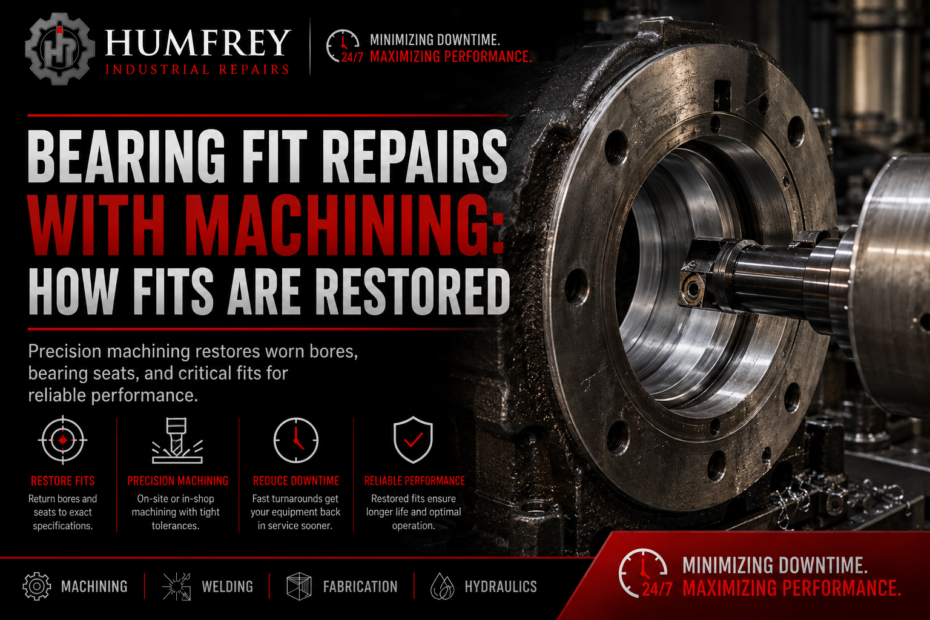
Bearings rely on accurately machined surfaces to operate properly. Whether a bearing is mounted on a shaft or installed inside a housing, the fit between the components must remain within the required dimensional tolerance. When a shaft journal wears undersize or a housing bore becomes oversized, the bearing may begin to move, spin, vibrate, or lose proper alignment. Over time, this can damage the bearing, shaft, housing, seals, and other components throughout the machine. Fortunately, worn bearing fits do not always require complete component replacement. Bearing fit repairs using precision machining and appropriate restoration methods can often return damaged shafts and housings to service while extending the life of expensive industrial equipment.
At Humfrey Industrial Repair, precision machining is regularly used as part of equipment repair and component restoration for Alberta’s industrial, oil and gas, manufacturing, agricultural, and heavy-equipment sectors.
What Is a Bearing Fit?
A bearing fit refers to the dimensional relationship between the bearing and the surface where it is installed.
Most bearing assemblies involve two primary fits:
- The bearing inner ring fitted onto a shaft or journal
- The bearing outer ring fitted into a housing or bore
Depending on the application, the fit may require a specific amount of interference or clearance.
Correct bearing fit depends on several factors, including:
- Bearing size
- Load direction
- Load magnitude
- Shaft rotation
- Operating temperature
- Housing material
- Shaft material
- Required running accuracy
- Installation requirements
Even relatively small dimensional changes can affect how securely the bearing remains positioned during operation.
What Causes Bearing Fits to Wear?
Bearing seats can deteriorate for several reasons.
Common causes include:
- Bearing movement or spinning
- Improper installation
- Insufficient interference fit
- Excessive vibration
- Misalignment
- Contamination
- Corrosion
- Overloading
- Repeated bearing failures
- Damage during previous repairs
Once movement begins between the bearing and its mounting surface, wear can accelerate quickly.
Common Signs of a Worn Bearing Fit
A worn bearing seat may not always be obvious during operation.
Warning signs can include:
- Repeated bearing failures
- Excessive vibration
- Unusual operating noise
- Bearing movement inside the housing
- Heat around the bearing location
- Fretting or polishing marks on the shaft
- Oversized housing bores
- Undersized shaft journals
- Misalignment between bearing locations
If a replacement bearing repeatedly fails, the bearing itself may not be the root cause. The shaft or housing fit should also be inspected.
How Shaft Bearing Fits Are Repaired
When the bearing seat on a shaft becomes worn, simply installing another bearing may not solve the problem.
The shaft must first be measured to determine the amount and location of wear.
Depending on the component and application, the repair may involve restoring material to the journal and then machining the surface back to the required diameter and finish.
Common restoration approaches can include:
- Approved weld build-up followed by machining
- Thermal spray or metal deposition processes
- Sleeving where appropriate
- Manufacturing a replacement shaft when repair is not practical
The restored journal is then precision machined to achieve the required bearing fit.
Repairing Oversized Bearing Housing Bores
Bearing housings can also wear oversized, particularly when the outer bearing ring has moved or spun inside the bore.
This may result in:
- Loss of bearing retention
- Poor alignment
- Excessive vibration
- Damage to the housing
- Accelerated bearing wear
One repair approach involves machining the damaged housing bore to restore geometry and then rebuilding the bearing location using an engineered sleeve or another suitable restoration method.
The repaired bore can then be finish-machined to the required diameter, alignment, and surface condition.
Why Precision Measurement Is Critical
Bearing fit repairs begin with accurate inspection.
Machinists must determine:
- Existing shaft diameter
- Existing housing bore diameter
- Roundness
- Taper
- Alignment
- Surface condition
- Amount of material loss
Measurements are then compared against the requirements of the bearing and equipment application.
Without accurate inspection, a repaired component can still experience premature failure even if the surface appears visually acceptable.
The Importance of Alignment
Correct diameter is only part of a successful bearing fit repair.
Bearing locations must also maintain proper alignment.
If two bearing bores are out of line, the shaft may experience additional stress even when each individual bore measures correctly.
Misalignment can contribute to:
- Bearing overheating
- Uneven loading
- Shaft wear
- Seal failures
- Excessive vibration
- Reduced bearing life
For housings with multiple aligned bores, precision boring or line boring may be required to restore the proper relationship between bearing locations.
Surface Finish Matters Too
Bearing seats require more than dimensional accuracy.
The surface finish must also be appropriate for reliable installation and operation.
Poor surface condition can affect:
- Bearing seating
- Contact between components
- Dimensional consistency
- Installation
- Long-term bearing retention
Precision turning, boring, grinding, or other finishing processes may be used depending on the repair and required tolerance.
Why Installing a New Bearing Alone May Not Fix the Problem
One of the most common mistakes during equipment repair is replacing the bearing without investigating why the original bearing failed.
If the shaft or housing has already worn outside its required dimensions, a new bearing may still fit incorrectly.
The result can be another premature failure.
When bearings repeatedly fail, technicians should inspect the entire assembly, including:
- Shaft condition
- Housing condition
- Bearing fit
- Lubrication
- Alignment
- Loading conditions
- Seals
- Contamination
Correcting the root cause provides a much more reliable repair than simply replacing damaged parts.
Repairing vs Replacing the Entire Component
Large industrial shafts, gearboxes, housings, and equipment assemblies can be expensive to replace.
In many situations, bearing fit repairs allow the original component to remain in service.
Potential benefits include:
- Lower repair costs
- Reduced equipment downtime
- Preservation of expensive components
- Faster turnaround compared with sourcing replacements
- Extended equipment lifespan
Whether repair makes sense depends on the amount of damage, component material, operating requirements, and overall condition of the part.
How Humfrey Industrial Repair Supports Bearing Fit Repairs
Humfrey Industrial Repair provides precision machining and industrial repair services for worn shafts, housings, and mechanical components.
Our capabilities can support repairs involving:
Shaft Machining
Worn journals and bearing locations can be inspected and machined as part of a suitable restoration process.
Housing Bore Repair
Damaged or oversized bearing bores can be evaluated and precision-machined to restore proper geometry and fit.
Line Boring
Multiple bores or large equipment assemblies may require line boring to restore alignment between bearing locations.
Welding and Component Restoration
Where appropriate for the material and application, damaged components may require material restoration before final machining.
Custom Component Manufacturing
When an original component is beyond economical repair or no longer available, replacement shafts, sleeves, bushings, and other components can be manufactured to specification.
Preventing Future Bearing Fit Damage
Once a bearing fit has been repaired, proper maintenance helps prevent the same problem from returning.
Important practices include:
- Using the correct bearing
- Following specified installation procedures
- Maintaining proper lubrication
- Monitoring vibration
- Preventing contamination
- Checking shaft and housing dimensions during rebuilds
- Investigating repeated bearing failures
- Correcting alignment problems
Preventing movement between the bearing and its mounting surface is critical to long-term reliability.
Final Thoughts
Worn bearing fits can cause vibration, misalignment, repeat bearing failures, and extensive equipment damage if they are ignored.
Fortunately, many damaged shafts and housings can be restored through a combination of precision measurement, component rebuilding, machining, boring, and finishing.
Bearing fit repair provides industrial operators with an effective way to extend equipment life and avoid replacing costly components unnecessarily.
At Humfrey Industrial Repair, we provide precision machining, line boring, welding, custom component manufacturing, and industrial repair services to help Alberta businesses restore worn equipment and keep critical machinery operating reliably.